Monday, February 17, 2014

Monday Mosaic: Burst of Color

curated by Susanne from enchantedhue

The East Coast of the US has been pummeled by yet another snow storm.

I for one crave some warmth and color.

So let's see what members of the Boston Handmade Team have to offer:


Poppin-220 Yards of Peruvian Yarn by ladydyefiberarts
Felted Wool 9x9 Inch Squares by straynotions
Paper Quilt Art Collage by JessicaBurko
Large Striped Beach Tote Bag by LidaBrookeDesigns

Friday, February 14, 2014

Valentine Be Mine

by Jessica Burko


I used to make cards, gifts, cookies, cupcakes, and all kinds of valentine everything for everyone. Friends, family, coworkers, classmates, you name it. From mid-January through February 14th I was pink, red, and all sorts of hearts and lace, cupids, and kisses. Oh the days of endless crafting. They are far behind me.


These days, I help my kids make valentines for their teachers and everyone in their classes, for their Nana and NingNing, Aunties and Uncles, and random siblings of their classmates that for some reason they insist on making valentines for. Since they are two and four years old the help I provide is largely in the form of making sure no one eats the glitter or grabs, well, anything after putting their whole hand on the ink stamp pad. I try to provide a wide variety of supplies and then step back and let them explore their creativity however they choose.

Sometimes I miss my extreme crafting days of the past, but seeing my children explore what they can make with their own tiny hands is pretty amazing, and knowing that I am helping them develop a love for all things handmade warms my heart. On this snowy Valentine's day, that is an especially welcome feeling.

Wednesday, February 12, 2014

The Joy of Dyeing Silk. Part II: Commercial Dyes

by Susanne Guirakhoo of enchantedhue

Commercial fabric or silk dyes give a different dimension than natural dyes. The colors are more vibrant and more stable than some natural dyes, and different techniques can be used.

As with natural dyes (as explained in Part I), patterns can be achieved by different Shibori techniques: binding, stitching, folding, pressing according to ancient Japanese traditions.

The soft texture of silk lends itself to aquarelle painting. Silk paints are thin liquids and will flow and melt into the silk, feathering out gently. To prevent the colors from migrating too far, a hair dryer can be used to quickly dry the paints and stop further flowing.

Another traditional technique is called Serti or gutta resist. Gutta is a rubbery, solvent based resist that is applied with a squeeze bottle. Gutta comes in black, gold, silver, and clear and is used to outline the pattern, which can be very detailed, on the silk. When it is completely dry, silk paints are applied to the outlined areas. Instead of gutta, I prefer to use water-soluble resists, which are easier to use and can be tinted to any color. The finished piece can have a look similar to stained glass.

And then there are less precise techniques that yield more organic patterns.


Commercial silk paints can be manipulated in a number of ways while still wet. Salt, grains of rice, or small beans soak up some of the paint and give starburst-like patterns. Alcohol drops lighten the color. Water sprays dilute and give the appearance of soft waves.

Snow dyeing is one of my favorite dyeing methods. The serendipity of the outcome is truly fascinating. A piece of wet silk is put on top of a grate set on a container, piled high with snow, and dye is generously drizzled on top of the snow. The snow slowly melts, letting the dye hit the fabric at different times and concentrations. Rate of melting, temperature, amount, solution, and even color of dye influence the pattern. My most surprising piece was achieved with only the color black. During the melting process, the black was fragmented into its individual pigments, resulting in muted reds, blues, and browns.


The next technique to experiment with? Sugar syrup resist!

Tuesday, February 11, 2014

Newest Member of Boston Handmade: Early Bird Designs

BH: Tell us a bit about yourself. What is your background?

Jill Burns: I studied painting in college and after graduating went to work in the museum field. I was the registrar at the Worcester Art Museum, which was a wonderful environment for inspiration. Not only was I exposed to the great works in the gallery, but my favorite places were the storage areas. Lots of treasures there. I took ceramics classes several years later and was hooked!


 BH: How long have you been doing your artwork?

Jill Burns: I have been working in ceramics for over 20 years. About 12 years ago I was an artist in resident at the Worcester Center for Crafts so I could devote full time work at my craft. At the end of that I was awarded the Worcester Arts Council Fellowship. It was a marvelous validation to what I was doing and it gave me the courage to start a ceramic studio called the Fire Works, a suite of studios and shared equipment for ceramic artists.


BH: Tell us a little bit about Early Bird Designs. How did you come up with name?

Jill Burns: Early Bird Designs is my line of functional pottery and personal accessories. I am, in fact an early bird. Always have been. I could never sleep late even though the teens years. Plus I think it reflects the sort of fresh and playful take on the porcelain work that I have been doing for the past few years.


BH: Tell us about your work. How is it made and what are your inspirations?

Jill Burns: Most of the pieces start as porcelain slabs and are formed into functional ware, such as cups, platters, vases etc. When the clay has stiffened I inscribed a design and inlay a dark slip. That forms the base drawing, so subtle color can be added later in the process. The ware is very durable and can be used everyday and is fine in the dishwasher and microwave. Images are lively versions of grandmother’s bone china and 18th-19th animal and plant engravings. It is a marriage of my early training as a painter, with my love of clay.


BH: What can we expect from you in the next couple of years?

Jill Burns: I am always creating new forms and designs, but I have been thinking about doing a pottery subscription of some kind. Maybe a “Cup-of-the-Month”! I also have a small line of porcelain jewelry and accessories and I’d like to expand that as well. I usually post updates on my Facebook page, so check it out. www.facebook.com/Earlybirddesigns

Monday, February 10, 2014

Monday Mosaic: Hang it up!

curated by Sharon Fischer, Stray Notions


1. Fiber Art Wall Hanging in an oval hoop - the Zakim Bridge in Boston, Stray Notions
2. Original encaustic art collage, Jessica Burko
3. Nighttime at Jamaica Pond- 5x7 Photograph- Matted Print, Lucie Wicker Photography 
4. Tropical Paradise- Original Mixed Media Collage, McDonald Mixed Media

Saturday, February 8, 2014

SOWA Wearables Market - Today!

by Liz Stewart of Lush Beads Industrial

The SOWA Winter Market started on February 1st, and this coming Saturday is a special market - the Wearables Market!  This market focuses specifically on jewelry and other wearables, and is timed perfectly for Valentine's Day gift-giving.  Be sure to stop by and see the work of these Boston Handmade artists on TODAY, Saturday, February 8th, from 11-4 at 1500 Washington Street in Boston!

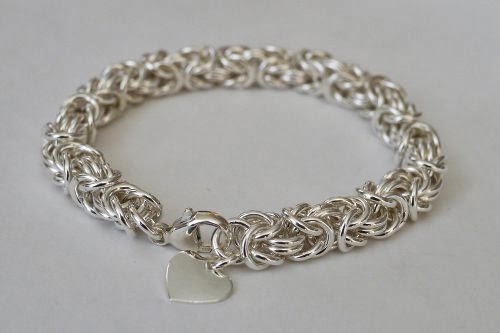
Chainmaille bracelet by Bev Feldman of Linkouture

Bev Feldman of Linkouture  is a jeweler who makes modern and elegant jewelry for women, featuring chainmaille jewelry. She is excited to be selling her newer line of sterling silver bracelets, made using rings made from recycled metal.


Just in time for Valentine's Day, Linkouture will  be selling delicate heart post earrings made from sterling silver and 24k gold plated copper. They are so sweet looking!  And for the month of February, Linkouture will be donating 20% of sales for any heart jewelry to Friends of the Center for Families, a nonprofit that holds a very special place in Bev's heart.


Fiber artist Leanne Tremblay of Loomination will be bringing handwoven scarves of all colors and styles. She will have cowl infinity scarves, traditional full length scarves, and her newest creations, double infinity scarves.


Cowl infinity scarves are worn by simply pulling them over the head, resembling a cowl neckline, and double infinity scarves wrap around the neck twice or can be worn long, for a wider variety of looks.  In addiiton, she has just completed several menswear inspired full length scarves that can be worn by either men or women that will debut at SOWA.


Finally, I will be debuting my new Industrial Swarovski stud earrings at SOWA!  Under my Lush Beads Industrial umbrella, I use new and repurposed hardware in unexpected ways, creating earrings, necklaces and bracelets. I work out of my studio at the Western Avenue Studios in Lowell.


I am best known for my Morse Code jewelry, which was recently featured in The Lowell Sun.  Morse Code necklaces use hardware to represent dashes and dots, spelling out a word or phrase.  The one pictured above spells "love".

This is sure to be a great market, so stop by 1500 Washington Street in Boston from 11-4 today!

Friday, February 7, 2014

Why Handmade: Valentine’s Day

by Lynn Mohney of Prunella’s Workshop

I don’t care for Valentine’s Day.
There. I said it.

I don’t necessarily buy into the idea where one day a year someone buys me jewelry, chocolate, and flowers to tell me they love me, because their calendar told them to. I do, however, think on occasion we should do something for the people we love, simply because we can. Despite my opinion, on February 14, men everywhere will be looking for gifts for the woman in their life, and as a professional artist, it is essential I am prepared with possible trinkets for their perusal.

Textured Heart Earrings by Prunella's Workshop

I am considering whether my line of jewelry supports a lot of heart-shaped items, or if simply having merchandise is sufficient. I do have some hearts worked in here and there, on a piece or two. Fortunately, unlike other holiday-themed items, such as Christmas trees or pumpkins, hearts are acceptable year-round. It is when we add wording such as “Be Mine,” that our work becomes specifically tied to Valentine’s Day. From a design perspective, hearts are fun to work with, as they come in more than one shape. There is the round plump heart, the asymmetrical heart, and the long narrow heart, just to name a few.

Day 46 - Valentine's Jewelry by slgckgc

It does bring me back to a time when I was younger, in elementary school. Everyone brought in a shoe box decorated with red, white, and pink construction paper, with a little slit on the top. We’d walk around the room, sliding handmade Valentine’s Day cards into everyone’s boxes. There were fewer commercial cards back then and more heart-shaped white doilies. You went through each and every one of those cards looking for the one from a special friend. To capture this feeling in a piece of art for the holiday; that would bring back the spirit of what Valentine’s Day should be.

Monster Truck Valentines by Janet

Thursday, February 6, 2014

The Joy of Dyeing Silk. Part I: Natural Dyes

by Susanne Guirakhoo of enchantedhue

While I am experimenting with yet another new technique to coax color and pattern out of plant material onto silk, I am reminded how very versatile and fascinating this medium is. In this Part I, I will talk about natural dyes. Part II will be about commercial dyes and ways to manipulate them.

In the beginning, I decocted dyes from coffee, tea, onion skins, turmeric. Predictable and easy, yet with interesting results.

Next I discovered berries, which are bit more fickle. Then black beans. Then came plants, roots, bark, berries, flowers, nuts, and leaves found on walks or in our garden. Whatever I thought holds potential for yielding color made its way into the dye pot.


The patterns were achieved by different Shibori techniques: binding, stitching, folding, pressing according to ancient Japanese traditions.


My research brought me to Kimberly Baxter Packwood’s blog. She is a mixed media artist specializing in surface design using natural dyes, rust, and wax. From her, I learned how to dye with rust and compost (well, the compost one went a bit wrong in the beginning. Kimberly lives in the desert, she leaves her fabric bundles in the compost pile for months. Doing the same in New England humidity results in complete disintegration and decomposition of the fabric. Not a thread was left after 3 months!). These techniques leave unpredictable patterns and colors, a surprise every time a bundle is opened.


Another one of my favorite fiber artists is India Flint. She describes herself as 'maker of marks, forest wanderer & tumbleweed, stargazer & stitcher, botanical alchemist & string twiner, working traveller, dreamer, writer and the original discoverer of the eucalyptus ecoprint'. Her approaches to dyeing with natural materials and achieving stunning patterns are unique and very inspiring. Her work touches me as being very poetic, as fragile and grounded at the same time. I have tried a few of her techniques with more or less satisfying results. And this newest one I am experimenting with has also been inspired by her.

So what is the new technique? Canning! Yes, canning! Stuffing a piece of silk with plant material, rolling it up and tyeing it tightly, putting it in a glass jar filled with boiled water which may or may not have been infused with other dye material, closing the jar air tight and letting it steep for weeks.


Can’t wait for the outcome!
Related Posts Plugin for WordPress, Blogger...